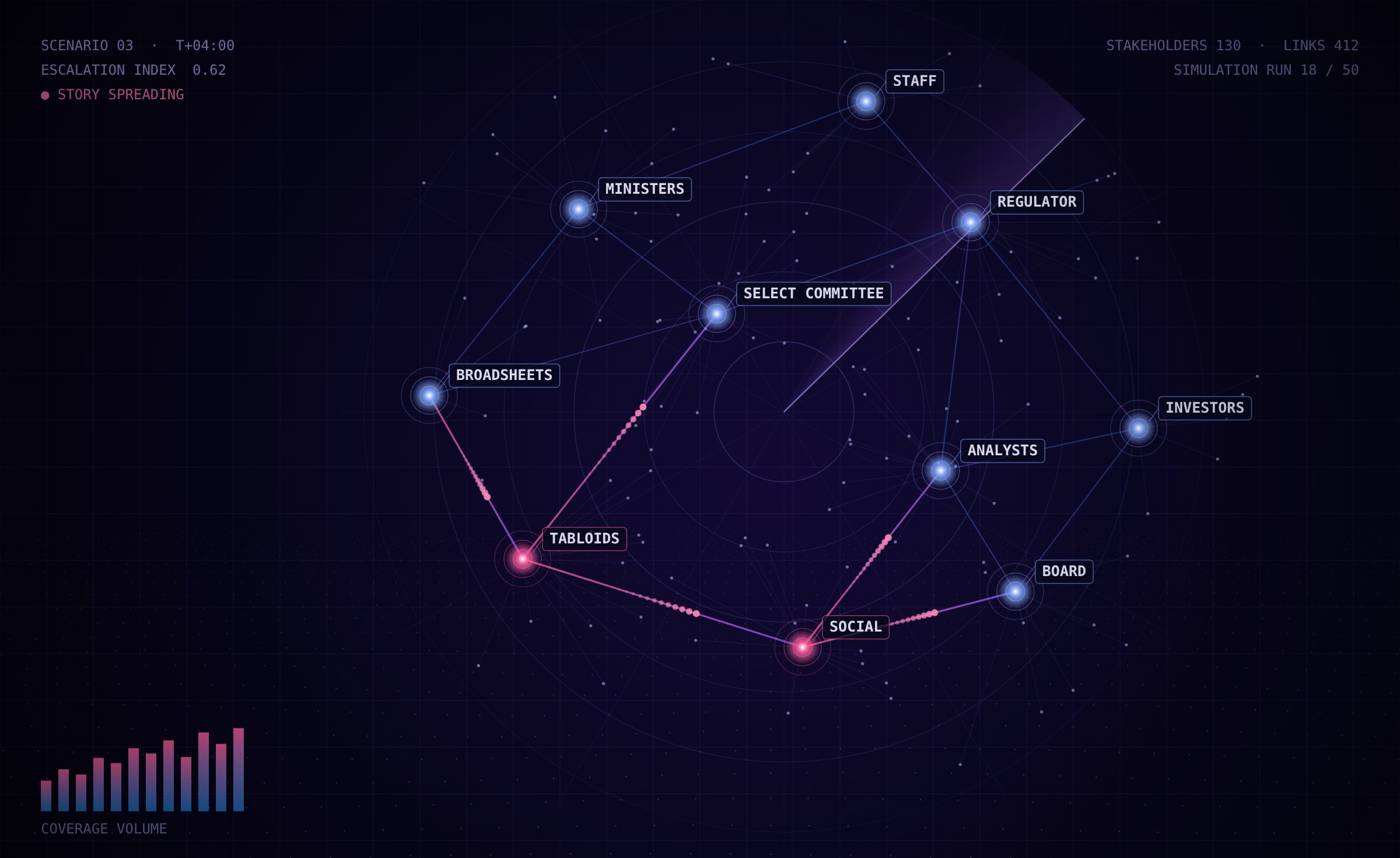
Crisis simulation for boards and leadership teams.
Emirali Advisory runs crisis wargames for boards and executive teams. Our technology models how regulators, politicians, the media and investors would react, so leaders can test their decisions before a real event tests them in public.
What is a crisis simulation?
A crisis simulation is a rehearsal of a serious incident in which a leadership team makes real decisions as the scenario develops. It tests whether the crisis plan, the people and the sign-off routes work under time pressure, before a real event tests them in public.
Exercises range from a short discussion around a table to a full day with live pressure from outside. There are three main types:
- Tabletop exercise. The team talks through a scenario step by step with a facilitator. It is a good way to check roles and the plan, and it suits a first exercise.
- Functional exercise. One part of the response, such as the communications team or the IT incident team, works through the scenario in real time with simulated messages and deadlines.
- Full simulation. The board and executive team respond to a developing scenario in real time. Journalists, regulators, investors, staff and politicians react to each decision. The scenario changes as a result.
Why boards run a crisis simulation exercise
An exercise shows whether people can carry out the crisis plan with incomplete facts and a journalist's deadline. Boards also face clear expectations to show that their response has been tested. For example:
- Corporate governance. Provision 29 of the UK Corporate Governance Code 2024 asks boards to declare whether their material controls are effective, for financial years starting on or after 1 January 2026. A tested crisis response supports that review.
- Operational resilience. The FCA and the PRA require many financial services firms to test, through severe but plausible scenarios, whether they can stay within impact tolerances for their important business services.
- Cyber security. The National Cyber Security Centre encourages organisations to exercise their response to cyber incidents. It publishes free exercise material, Exercise in a Box, for this purpose.
How our crisis wargames work
Scoping
We agree what the exercise should test, who should take part and what a good outcome looks like. We review your crisis plan and risk register.
Scenario design
We write a realistic scenario based on your sector and your real risks. Former journalists draft the coverage and the questions. Media lawyers check the legal points the scenario raises.
The crisis wargame
Your team responds in real time. Our proprietary simulation technology models how regulators, politicians, the media and investors would react to each decision. The scenario escalates or eases as a result. Participants receive calls from journalists, letters from regulators and questions from staff.
Hot debrief
Straight after the exercise, we review with participants what went well, where decisions were slow and where information did not reach the right people.
Report and follow-up
We send a written report with findings and recommended actions, each with an owner. We can then help you update the crisis plan, draft holding statements and train spokespeople.
Which scenarios should a crisis exercise test?
Choose scenarios that are plausible for your organisation and that require the board to make difficult decisions. Common scenarios include:
- Cyber attack and ransom demand. Systems are down, customer data may be exposed and the attackers contact the press. Under UK GDPR, a reportable personal data breach must be reported to the ICO within 72 hours of the organisation becoming aware of it.
- Allegations about the chief executive. A newspaper puts allegations about conduct to the company with a short deadline, and staff start to post about it online.
- Product safety or service failure. A fault harms customers. A recall, regulator involvement and questions about compensation follow.
- Regulatory or parliamentary scrutiny. A regulator opens an investigation, or a select committee asks the chief executive to give evidence.
- Whistleblower or leak. Internal documents reach a journalist or an MP.
What a good crisis management exercise looks like
- Clear objectives. Each exercise tests a small number of agreed points, such as the speed of the first statement or the sign-off route.
- The real decision-makers. The people who would lead the response take part, with their deputies. Crises often happen when key people are away.
- Realistic pressure. Deadlines, incomplete information and conflicting advice reflect what happens in a real crisis.
- Independent observers. Observers record decisions, timings and who knew what, so the debrief is based on facts.
- Action afterwards. Findings become specific changes to the plan, with owners and dates. Most organisations repeat the exercise at least once a year and after a major change, such as a new chief executive.
Why Emirali Advisory for crisis simulation
- Technology used by governments. Our simulation technology has been used by FTSE 100 companies and by governments, including the UK, Spain, Slovenia and Ukraine.
- Experience of real crises. Exercises are led by Leon Emirali, a former Chief of Staff to Rt Hon Steve Barclay MP as Brexit Secretary and Chief Secretary to the Treasury. He managed crises inside Westminster through Brexit and the pandemic.
- Journalists and lawyers on the team. Our senior associates include former tabloid and broadsheet journalists, former BBC broadcasters, data analysts and media lawyers. They play the roles that test your team.
- Senior advisers throughout. You deal directly with senior advisers, not account teams, from scoping to the final report.
- Confidential. Every enquiry and every exercise is confidential. We work alongside your lawyers, in-house team and existing agencies.
Questions about crisis exercises
What is the difference between a crisis simulation and crisis training?
Crisis training teaches skills, such as drafting a holding statement or handling a hostile interview. A simulation tests how a team uses those skills together in a realistic scenario with time pressure. Many organisations train their spokespeople and crisis team first. They then run a simulation to test the plan and find the gaps.
How long does a crisis exercise take?
Most board-level exercises run for half a day or a full day, followed by a debrief. A shorter tabletop exercise can take two or three hours. Preparation takes longer than the exercise itself, because the scenario, the coverage and the reactions of each audience are written for the organisation.
Who should take part in a crisis exercise?
The people who would lead a real response. This usually means the chief executive, the executive committee, the general counsel, the communications director and the heads of operations and technology. Non-executive directors often take part or observe. Deputies should also attend, because crises often happen when key people are away.
How often should we run a crisis exercise?
Most organisations benefit from at least one exercise a year, with a different scenario each time. It is also sensible to run one after a major change, such as a new chief executive, a merger or a large change to systems. Regulated firms should also follow the testing rules set by their regulator.
What is a crisis wargame?
A crisis wargame is an exercise in which a leadership team responds to an escalating scenario while other players react to each decision. Our crisis wargames use proprietary technology to model how regulators, politicians, the media and investors would respond. The board sees the likely consequences of its choices before it has to make them for real.
Can the scenario be specific to our organisation?
Yes. We design each scenario around your sector, your risks and the people who matter to your organisation. Former journalists write the coverage and media lawyers check the legal issues. The scenario and the findings are confidential to you, and we work alongside your lawyers and in-house team.
How much does a crisis simulation cost?
The fee depends on the scale of the exercise, the number of participants and how much of the scenario is built for you. We agree the scope and the fee in writing before any work starts. To discuss what you need, call 020 3984 8541 or email amber@leonemirali.com.
More crisis communications services
Senior counsel,
on your side.
For a live crisis, we reply immediately, 24/7.
020 3984 8541amber@leonemirali.com